
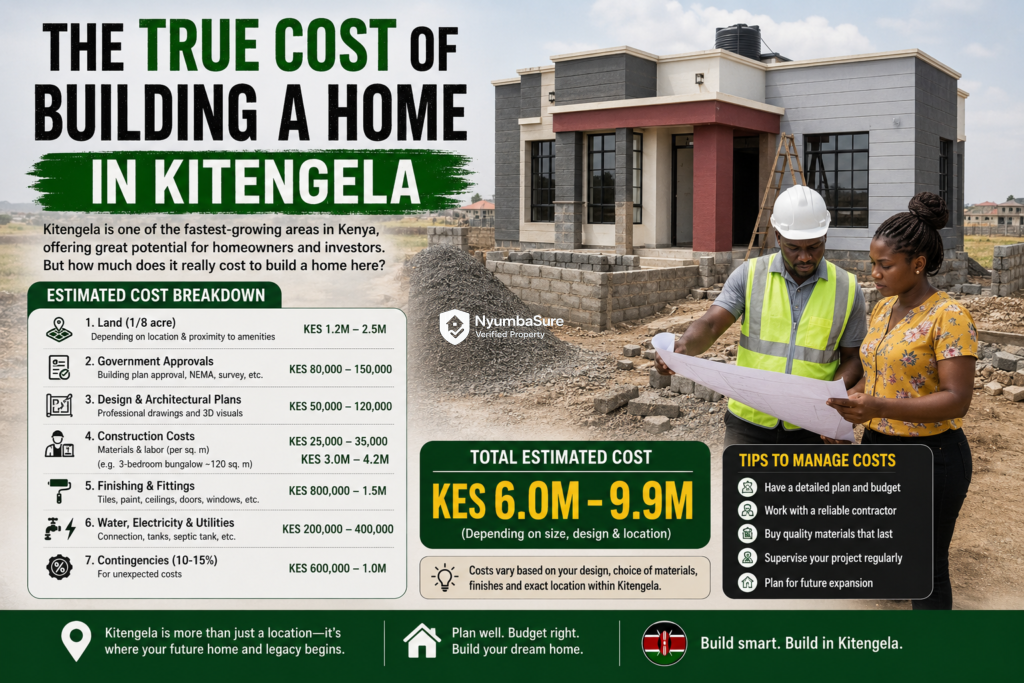
The True Cost of Building a Home in Kitengela
Introduction
One of the most common questions asked by both diaspora buyers and local investors is:
“How much does it actually cost to build a home in Kitengela?”
Unfortunately, many people receive unrealistic answers.
Some are told they can build a complete three-bedroom house for KSh 1.5 million.
Others are quoted KSh 10 million for relatively modest homes.
The truth lies somewhere in between.
The final cost of building depends on several factors, including location, house size, finishing standards, infrastructure requirements, labor costs, and site conditions.
Many first-time builders focus only on the house structure itself and forget numerous hidden costs that can significantly affect the budget.
This guide breaks down the real costs involved in building a home in Kitengela and highlights expenses that many homeowners overlook.
Why More People Are Building in Kitengela
Kitengela continues to attract home builders because it offers:
- Larger plots compared to Nairobi suburbs
- Relatively affordable land prices
- Growing infrastructure
- Expanding road networks
- Access to schools and hospitals
- Strong long-term appreciation potential
For many families, building in Kitengela allows them to own a larger home while spending less than they would in many Nairobi neighborhoods.
The Biggest Mistake First-Time Builders Make
Most people calculate:
Land Cost + Construction Cost
Unfortunately, that is rarely the full picture.
Actual costs often include:
- Land purchase
- Legal fees
- Stamp duty
- Site preparation
- Water infrastructure
- Septic systems
- Security walls
- Electricity connection
- Landscaping
- Cabro paving
- Furniture
The result is that many projects exceed their original budget by millions of shillings.
Typical Cost of Building a 3-Bedroom Home in Kitengela
For planning purposes:
Basic Finish
Approximate construction cost:
KSh 35,000–45,000 per square meter
Mid-Range Finish
Approximate construction cost:
KSh 45,000–65,000 per square meter
Premium Finish
Approximate construction cost:
KSh 65,000–100,000+ per square meter
A typical three-bedroom bungalow measuring 120–150 square meters can therefore cost anywhere between:
Basic
KSh 4.2M – 6.8M
Mid-Range
KSh 5.5M – 9.5M
Premium
KSh 8M – 15M+
The exact figure depends heavily on specifications and finishes.
Cost #1: Land Acquisition
Land remains the foundation of the project.
Depending on location:
Emerging Areas
Lower acquisition costs but less developed infrastructure.
Established Areas
Higher prices but stronger amenities and accessibility.
Areas such as:
- Milimani
- Acacia
- Muigai
- Riverine
- Yukos
- Ideal Namelok
often command different prices depending on infrastructure, accessibility, and demand.
Cost #2: Legal and Transfer Fees
Many buyers forget these costs.
Common expenses include:
Land Search Fees
Ownership verification.
Legal Fees
Advocate representation.
Stamp Duty
Government transfer charges.
Valuation Fees
Required in certain transactions.
These costs can add hundreds of thousands of shillings to the project.
Cost #3: Site Preparation
Not every plot is ready for construction.
You may need:
- Bush clearing
- Debris removal
- Excavation
- Filling and leveling
- Soil testing
Some plots require very little work.
Others can require substantial investment before construction even begins.
Cost #4: Boundary Walls and Security
Many Kitengela homeowners prioritize security immediately after purchasing land.
Common options include:
Chain Link Fence
Most affordable.
Stone Wall
More secure and durable.
Stone Wall with Electric Fence
Popular in higher-end developments.
For many homeowners, perimeter security becomes one of the first major investments.
Cost #5: Water Infrastructure
This is often underestimated.
Depending on location, you may require:
Water Connection
Where utility services are available.
Borehole Access
Common in many developments.
Water Storage Tanks
Essential for consistent supply.
Pump Systems
Required in some installations.
Without proper planning, water infrastructure can become a major surprise expense.
Cost #6: Septic Tank and Waste Management
If sewer infrastructure is unavailable, homeowners typically install:
- Septic tanks
- Soak pits
- Drainage systems
These costs are frequently forgotten during budgeting.
Cost #7: Electricity Connection
Connection costs vary depending on:
- Distance to existing infrastructure
- Transformer availability
- Development requirements
Additional expenses may include:
- Internal wiring
- Distribution boards
- Security lighting
- Backup systems
Cost #8: Solar Systems
Many homeowners are increasingly installing solar systems to reduce long-term electricity costs.
Benefits include:
- Reduced utility bills
- Backup power
- Energy independence
Solar is becoming particularly attractive for diaspora homeowners managing future operating expenses.
Cost #9: Driveways and Cabro Paving
After completing the house, many owners realize they still need:
- Parking areas
- Walkways
- Driveways
Cabro paving significantly improves aesthetics and usability but requires additional budget allocation.
Cost #10: Interior Finishes
This category creates the largest variation in construction costs.
Examples include:
Flooring
- Ceramic tiles
- Porcelain tiles
- Hardwood finishes
Kitchens
- Standard cabinets
- Custom cabinetry
- Premium countertops
Bathrooms
- Standard fixtures
- Luxury fittings
Ceilings
- Standard ceilings
- Gypsum designs
- Decorative lighting
Finishes often determine whether a project remains within budget or exceeds expectations.
Building in Phases: A Smart Alternative
Many successful homeowners do not complete everything at once.
A phased approach may include:
Phase 1
- Land purchase
- Fencing
- Water connection
Phase 2
- Foundation
- Structure
- Roofing
Phase 3
- Interior finishing
Phase 4
- Landscaping
- Cabro
- Additional improvements
This strategy reduces financial pressure while allowing continuous progress.
Build or Buy? Which Makes More Sense?
Buying Existing Property
Advantages:
- Immediate occupation
- Known final cost
- Faster process
Challenges:
- Limited customization
- Potential hidden defects
Building
Advantages:
- Complete control
- Customized design
- Potential cost savings
Challenges:
- Longer timeline
- Project management requirements
- Risk of cost overruns
The right choice depends on your goals, budget, and available time.
Budgeting Tips for Diaspora Buyers
Before starting construction:
Add a Contingency Fund
Reserve at least 10–20% above projected costs.
Verify Contractor Credentials
Always request references.
Use Written Contracts
Avoid verbal agreements.
Require Detailed Bills of Quantities
Understand where every shilling goes.
Conduct Independent Inspections
Verification is cheaper than correcting mistakes.
The NyumbaSure Approach
Building a house involves more than construction costs.
Location matters.
Infrastructure matters.
Neighborhood quality matters.
Future appreciation matters.
Before purchasing land or beginning construction, buyers should understand:
- Accessibility
- Water availability
- Security
- Schools
- Hospitals
- Future growth potential
A beautiful home in the wrong location can become a poor investment.
Good decisions begin with good information.
Conclusion
Building a home in Kitengela remains one of the most effective ways for families and diaspora investors to create long-term value.
However, successful projects require realistic budgeting.
The true cost extends far beyond bricks, cement, and roofing sheets.
When planning your project, remember to account for:
- Land acquisition
- Legal fees
- Infrastructure
- Utilities
- Security
- Finishes
- Contingencies
The homeowners who enjoy the smoothest projects are not necessarily those with the largest budgets.
They are the ones who plan thoroughly before construction begins.
Know Before You Build.
Comments